Literature Review
Video Game Rating System
A Review of the Literature
Juan Lozano
English 1312
Professor Rice-Fourzan
March 23, 2010
Video Game Rating System:
A Review In Literature
Since 1994, the ESRB, (Entertainment Software Board), has been created by the necessity of many concerned parents, psychologists, and others who wanted to make games and their ratings recognizable based on the content of the games. The fact that also led to the creation of this video game rating system is to prevent anyone from playing mature games who do not meet the age requirements so that they are not influenced by mature content or foul language. The rating system was sort of like a pill to prevent the youth from being corrupted from the media. These questions are drawn upon from this issue:
1. Do you know or have ever heard about the ESRB, also known as the rating system used to rate video games?
2. If you are under the age of 17 or have a child, would you let yourself or your child play video games that exceed their age limit based on the rating?
3. Based on research there aren't many A-rated games. This rating is an adults only rating, which means only people 18 and over are allowed to purchase and play the content. Do you think there should be more A-rated games?
Do you know or have ever heard about the ESRB, also known as the rating system used to rate video games?
Before 1994, some people didn’t seem to mind or care about what they were playing as long as it was entertaining. There were no ratings assigned to video games until after the ESRB came into place. The ESRB was formed by the Entertainment Software Association by the help and enforcement of a video game rating system suggested by political branches and committees, during 1993-1994. People who purchase and own games know that the rating symbol appears in the front of game boxes and the descriptors for ratings are shown in the back. The factors for rating games are based on “pertinent content” (Vance, 2007, p.22), also known as anything that affects the rating of a game like violence, sex, or anything mature.This rating system needed to be implemented because so many concerned parents and even politicians wanted to make sure no kids were being harmed by the presence or influence of explicit content in video games, especially in other forms of media. The rating labels of the ESRB are divided into age groups as well as the content that goes along with that group. The rating of CE, (Early childhood: ages 3 and up), is intended for toddlers and small kids. The rating E, (Everyone: ages 6 and up), is intended for kids and does not have any bad content that parents need to be concerned about. The rating E10+, (Ages 10 and up), can contain some mild themes but nothing too racy; like cartoon violence. Rating T, (Teen: ages 13 and up) has some explicit themes, language, and minimal blood; this content fit’s the rating of a PG-13 film. Rated M, (Mature: 17 and up) definitely has adult themes like excessive violence, drugs, and nudity; kind of like a rated R movie. The most controversial rating is the AO, (Adults Only: 18 and up), and has the most adult content there is when it comes to ratings. Technically, not many people have games that are rated AO because there are either hard to find or many game companies just don’t make any of them.
If you are under the age of 17 or have a child, would you let yourself or your child play video games that exceed their age limit based on the rating?
Many Parents are especially concerned about letting their children play video games that exceed their child’s age limit. Knowing about the ESRB and checking in the front of game boxes for ratings can help avoid parents from buying elicit, profane video games for their children.
Below is a graph that was answered by respondents of a survey that represents feedback.
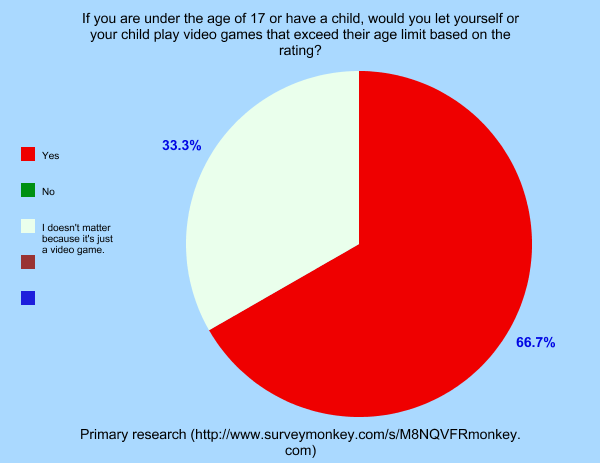
Based on the pie chart, the majority of the respondents do not mind letting themselves or their children play video games that have a high rating. One respondent, Moreno, was part of the 33.3% of the group shown in the figure above and made a comment. He said, “video games and reality do not mix, and that people shouldn’t get the two confused.” Based on the results on the survey, it is stated that people play video games because they want to enjoy a nice escape from reality or something to channel boredom or feelings. As for teenagers, they usually are already used to the profanity and content that are displayed in some games, and are not affected by it; they have seen or played a lot of mature games and are “generally accepting of profanity and verbal aggression in both media and real life” (Ivory et. all, 2009, p.457).
Based on research there aren't many A-rated games. This rating is an adults only rating, which means only people 18 and over are allowed to purchase and play the content. Do you think there should be more A-rated games?
In the ESRB’s homepage, (http://www.esrb.org), it contains a video game rating search. This can be very useful in determining the ratings of every single game that the ESRB has covered. You can also search for any particular game which will have its rating, along with the descriptors that go with that rating. It turns out that there are only 23 games out of the many the ESRB has rated that have an Adults Only, (AO) rating, and the majority of those rated games are for the PC. Today, not many people play with PC’s; the console generation has taken over the majority of gaming with millions of Americans owning gaming consoles. One respondent, Maloney, from the primary research survey says that there should be more games with the adults only rating because people would want to be curious of what these kinds of games show and what kind of experience they will be getting from playing them. Excessive violence and strong sexual content, especially nudity, are the two main descriptors to an AO rated game. Another respondent, Herrera, says that he would also like to see more AO rated games because “It’s not about how explicit a game can be to make it great, I personally don’t care about that as long as the QUALITY of the game is good.” These respondents and many others would to like have AO rated games in consoles and experience what they’re missing out on.
In closing, the video game rating system, ESRB, was a way to prevent the youth from being corrupted by implementing ratings on games by age groups. This prevents any child from purchasing games that contain mature themes and lets parents decide what’s best for their children. Adults don’t always have to buy and play games that fit with their age group; they can also play games that are under their age group because for some, video games aren’t played just because of how much mature or explicit it can be. No, games are played and enjoyed based on the quality and what types of genres of video games people are into, regardless of the rating. As President Patricia Vance of the ESRB says, “I’m a firm believer that kids learn their morals and values from influential people in their lives, not from the media they consume” (Galang, 2007, p. 22).
References
Congress, Senate, Committee on the Judiciary, Subcommittee on Juvenile Justice. (1995). Rating Video Games: A Parent’s Guide to Games. U.S. Government Printing Office. Washington.
ESRB (Entertainment Software Rating Board). (ã1998-2010). ESRB homepage. Retrieved March 22, 2010 from http://www.esrb.org.
Galang A. (September 4, 2007). THE WATCHFUL EYE OF GAMING. PC Magazine. 26(17) p.22.
Ivory J, Williams D, Martins N, Consalvo M. (August 2009) Good Clean Fun? A Content Analysis of Profanity in Video Games and Its Prevalence across Game Systems and Ratings. CyberPsychology & Behavior. 12(4) p.457-460.
McCann S. Game Ratings Rundown. (February 15, 2009) Library Journal ;134(3) p.85.
