Online Opinion Piece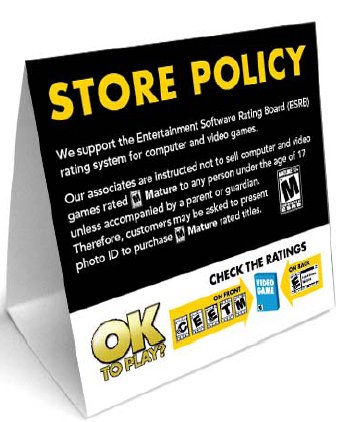 Image uploaded from http://origin.arstechnica.com/news.media/esrb-2.jpg 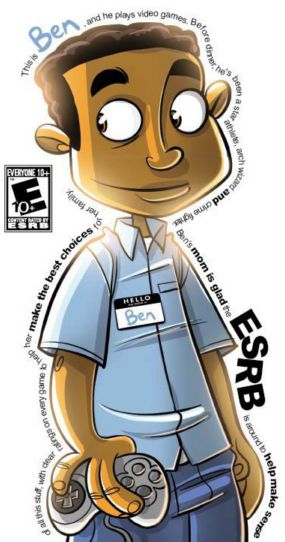 Image uploaded from http://www.playbrains.com/blog/wp-content/uploads/2009/06/esrb_ad2_full.jpg |
Showing I.D. for Video Games
Like in many places, people need to show identification in order to enter a certain facility or engage in a type of activity like clubs, bars, movie theaters, casinos, etc; but what if I told you that you needed to show your I.D. for games? Well for some it’s surprising because they have never heard about it, and for others it’s pretty common.
Ever since the ESRB, the video game rating system, was created in 1994 many concerned parents and politicians were relieved. The system is based on rating video games based on the content that they show. The video game labels are shown in the front of video game boxes as well as descriptors that show what kind of content is contained. The rating system can help parents make informed decisions about which game is age appropriated for their kid, along with the appropriate genres for them. Well, now that the ratings are enforced on games let’s call upon a situation. What if a minor tries to buy a video game that doesn’t fit their age requirement?
In some video game retail stores there are store policies that enforce the employees to make sure they are not selling mature games to minors. Notice how the policy is a “store” policy. Maybe it would be better if this kind of policy was enforced in not just video game stores, but in places that sell games in general. That way, parents and others alike won’t have to worry about their children being corrupted by the mature content of some games.
There was one instance where I noticed a store clerk did not ask a little child for I.D. when he purchased a game. It was last year and I was in a Gamestop store just browsing around when I noticed a little boy, maybe 9 or 10 years old trying to purchase a rated mature game. Without hesitation, the clerk sold the game to the minor without asking I.D. I was literally shocked when I saw this happening. I felt as if the employee wasn’t doing his job just as the store and its policy asks him to. I’m sure there are many other cases like these where Gamestop clerks don’t ask for I.D. to minors when purchasing mature games, but does Gamestop really need the money so bad without even thinking of the consequences of the mature games that they’ve sold to minors?
We as people should try to enforce the policy of showing I.D. when purchasing video games as a national policy, not just a store one. Just think about that little boy that I mentioned earlier, the one who bought the mature game and was not asked to show identification. What if his behavior was deeply changed and he could not tell what was real and what was not? Just by playing that one game…
Its instances like these that we should try to convince national policy makers about this dilemma so that future generations can feel safe knowing that their kids aren’t being sold mature games by themselves without proper identification, or at least with an adult present.
References
ESRB (Entertainment Software Rating Board). (ã1998-2010). ESRB homepage. Retrieved March 22, 2010 from http://www.esrb.org.
Galang, A. (September 4, 2007). THE WATCHFUL EYE OF GAMING. PC Magazine. 26(17) p.22.
http://origin.arstechnica.com/news.media/esrb-2.jpg. Accessed on May 5, 2010 at arstechnica.com/gaming/news/2007/06/esrb-targ. Google: Images |


